Grief is a universal experience that touches the lives of everyone at some point. Coping with loss can be an overwhelming journey, and finding effective ways to navigate through these times is crucial. Grief journals are more than just notebooks filled with blank pages; they are places of comfort for those who are grieving. These journals provide a safe space to express emotions, thoughts, and memories, allowing individuals to navigate the complexities of grief at their own pace.
By putting pen to paper, individuals can externalize their internal turmoil, fostering a sense of catharsis and emotional release. Some of the benefits of journaling include externalizing emotions, gaining insights into inner thoughts, and facilitating the healing process. Journaling creates a safe space for expression and allows individuals to explore their feelings. Because grief is not linear, they can revisit these pages throughout their grief journey as their feelings evolve.
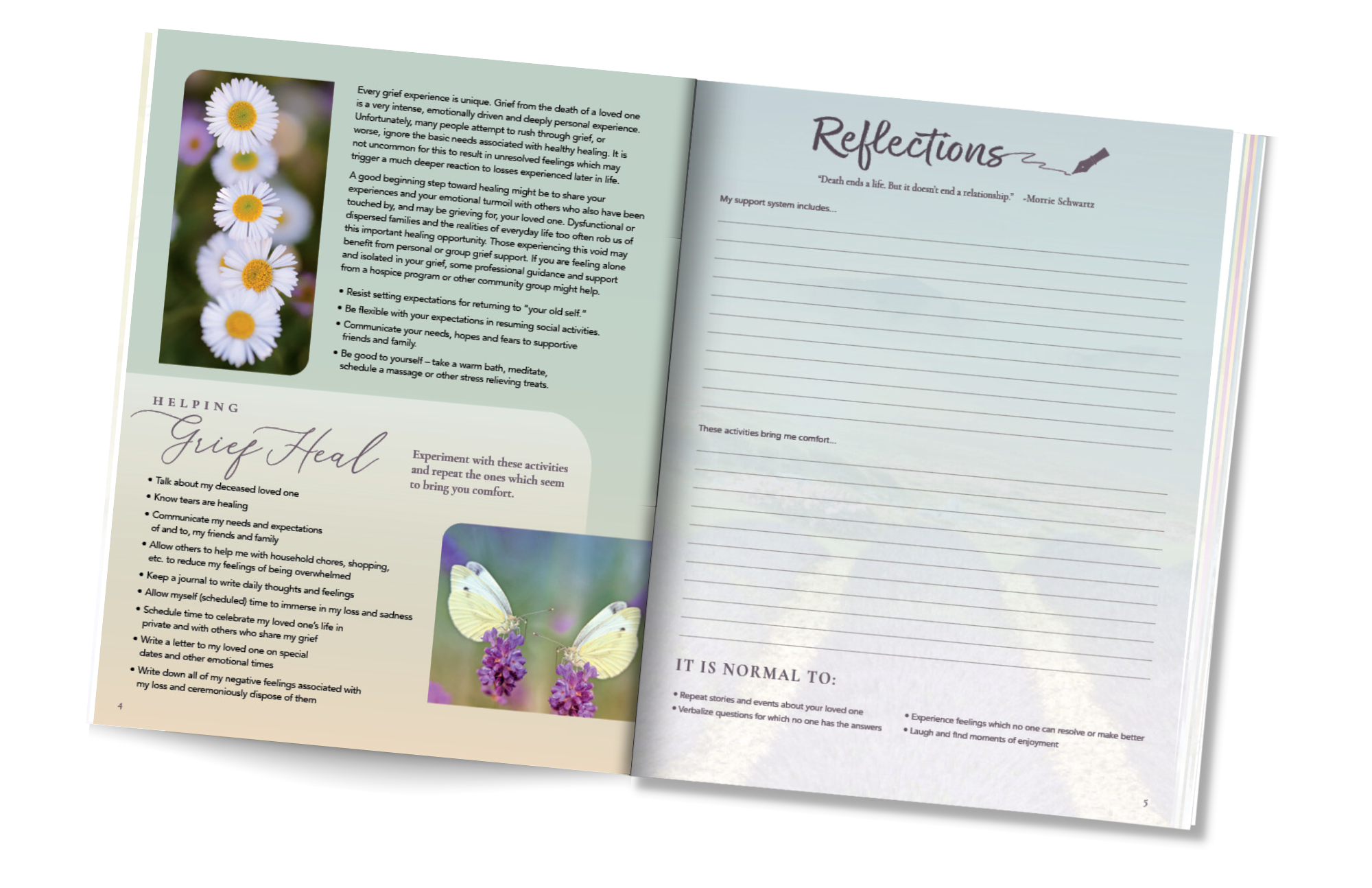
Hope Through Healing’s grief journal, Reflections, was curated with empathy and understanding. It provides information and correlating prompts that align with the individual’s grief to support them as they navigate this challenging path. The structured format of Reflections guides individuals through various aspects of their grief, including from the first month through the first anniversary plus a special informational issue on navigating the holidays.
Reflections is customizable. Print your own custom message, logo, contact information on a clear label and place it on the inside cover!
It includes 14 journal prompts that correlate to the information pages. The information pages provide helpful information on processing grief and validating the feelings without it being too overwhelming.
It offers a variety of resources including websites, books, and podcasts, for those who need something a little different.
There is a special information page for grieving during the holidays. This information can be referred to long after the first year after a loss. It takes time to heal, and grief is something we integrate into who we are.
We also have bulk pricing available. This is great for organizations who want to use this in a grief or counseling group.
Reflections is intended to be used over the course of a year. However, everyone’s grieving timeline is different, and the pace should be adjusted to their needs.
Be the Missing Link Between our Journal and Your Families
Industries or organizations who may benefit from our grief journal include churches , financial planners, and funeral homes.
Churches: Finding Comfort in Community Churches play an important role in providing support to their congregations during times of grief. Incorporating Hope Through Healing’s Reflections into church programs can be a powerful way to offer practical assistance to those in mourning. Churches can utilize Reflections as part of grief support groups, where offered. Structured prompts can facilitate group discussions, allowing individuals to share their experiences and support one another. By integrating the grief journal into church programs, communities can foster a culture of empathy, understanding, and healing.
Funeral Homes: Beyond the Service Funeral homes are often the first point of contact for individuals experiencing loss. By offering Hope Through Healing’s Reflections as part of their services, funeral homes can differentiate themselves while providing a meaningful resource to support grieving families. Reflections can serve as a valuable tool for funeral directors during grief counseling sessions, if offered. It can be included in memorial packages or provided as a complementary offering, demonstrating the funeral home’s commitment to holistic care.
Financial Planners: Aiding in More Than Finances Financial planners help their clients plan for life and reach their goals. When loss invariably affects their clients, having the right tools can help build trust and connection. Offering the Hope Through Healing grief journal enables financial planners to offer comfort and help their clients navigate this difficult transition.
Conclusion
Hope Through Healing’s grief journal, Reflections, in its structured format and thoughtful prompts provide an outlet for self-reflection, allowing individuals to process their emotions and find hope in the healing process. Beyond its benefits for individuals, Reflections offers valuable support for churches, financial planners, and funeral homes, bridging the gap between emotional and practical aspects of grief. As we continue to explore innovative approaches to grief support, Hope Through Healing’s Reflections stands out as a powerful tool, offering hope, healing, and comfort through journaling.
“The Hope Through Healing sympathy card and Grief Series that followsgives us theopportunity
to express words from the heart to our bereaved families; that they are uniqueindividual,
and that our care has not ended with the passing of their loved on.“ -St. Luke’s Hospital
What is the Grief Mail Series
The Grief Mail Series is a six-part series of informational grief mailings that provides comfort, peace, and hope during the difficult process of healing.
It is intended to be mailed out over the course of the first year after the death of a loved one. The suggested intervals are 30 days, 3 Months, 6, 9, 11, and 13 Months. These time frames are designed to align with the mourning stage the grieving families find themselves in. Each issue comes in packs of 25, 50, or 100.
“A spouse reached out to me recently saying each issue had just the words of encouragement and help she needed in her grief journey at that time.“ -Pointe Coupee Hospice
“Again and again I hear ‘that pamphlet arrived just as I was feeling sad or depressed.” -Michigan Palliative and Hospice Care
Benefits of the Grief Mail Series
Our Grief Mail Series is simple and easy-to-use. It helps standardize bereavement care programs across larger organizations, departments, or multiple branch offices.
Our Grief Mail Series is also available in a bundled format to allow for smaller organizations to be able to provide the bereavement care their families need without the need to purchase 25 of any one issue. Many start-up hospices will start with this bundle and as they grow, they will order larger packs. The Grief Mail Series Bundle includes:
10 pack of the 30-Day Issue
10 pack of the 3 Month Issue
10 pack of the 6 Month Issue
10 pack of the 9 Month Issue
10 pack of the 11 Month Issue
10 pack of the 13 Month Issue
10 pack of the Holiday Issue
The Grief Mail Series Bundle is also available in our Spanish Series for organizations who have Spanish speaking families they serve, but who may not need 25 of any 1 issue. Provide bereavement or grief support to your families in a language they understand, see Products listed below for which languages are available. Would you the Grief Mail Series in a language not provided?Submit a contact request for feedback.
Our Grief Mail Series is a cost-effective way to provide the bereavement care and grief support your families need. We offer bulk rate discounts:
The Grief Mail Series assists and is designed to help meet the bereavement support requirements set by Medicare and Medicaid: The U.S. Centers for Medicare & Medicaid Services (CMS) requires hospices to offer bereavement care for a minimum of 13 months following a patient’s death, but many providers extend those services to their entire communities regardless of whether the deceased was a patient. (https://hospicenews.com/2022/08/11/federal-bill-calls-for-bereavement-care-consensus-standards/)
We can provide a tracking sheet for you to stay on top of your scheduled Grief Mail Series dates and to keep track of everything you have previously mailed for audit purposes. We can email this sheet to you, or you can find it on our website. It is completely complimentary.
Each Grief Mail Series Issue is customizable. We have intentionally left the middle panel blank for you to add your own custom message, logo, and/or contact information. We highly recommend and encourage our customers to include a phone number or email for their families to contact them directly for more support. We can also provide sample messages to inspire your custom message.
We can imprint your customization for an additional fee, and when you receive your Grief Mail Series it will be ready to be sent to your families.
We can also provide you with all the tools for you to customize as you go. (Templates, sample messages, and how to instructional video.)
Our Products
Grief Mail Series Our Grief Mail Series is our most used product by hospices throughout the U.S. The issues that are part of this series are:
30-day Issue: This issue has the newly grieving in mind.
3 Month Issue: This issue addresses common reactions in grief.
6 Month Issue: This issue addresses the complicated emotions of grief.
9 Month Issue: This issue reflects on loneliness and offers hope and tips for self-care.
11 Month Issue: This issue offers fresh perspectives for facing the first-year anniversary of the death.
13 Month Issue: This issue makes a great closing piece for your bereavement program.
7 Languages: Our Grief Mail Series is available in seven languages. Support your grieving families in a language they understand.
English: Our full Grief Mail Series as listed above.
Spanish: Our full Grief Mail Series (plus Holiday) is available in Spanish.
Mandarin: Our full Grief Mail Series (plus Holiday) is available in Mandarin.
Korean: Our full Grief Mail Series (plus Holiday) is available in Korean.
Vietnamese: Our full Grief Mail Series (plus Holiday) is available in Vietnamese.
Russian: Our full Grief Mail Series (plus Holiday) is available in Russian.
Polish: Our full Grief Mail Series (plus Holiday) is available in Polish.
Special Stand-Alone Issues
Holiday: This issue addresses how to navigate the holidays without your loved one.
Isolation: This issue is appropriate for anyone grieving in isolation.
Suicide: We have two grief support issues for Suicide. These Suicide grief support issues address the complexities of grief experienced by suicide survivors.
Child Loss: This issue is to help guide parents, caregivers, and/or
Supporting your staff can seem difficult when you don’t know where or how to start. There are many ways organizations can provide support to their staff, and many reasons to do so as well. Providing support may be crucial in preventing burnout, frustration and/or anxiety. Those on the frontline are working long, stressful hours, and often, with no support to them. According to Mental Health America:
93% of health care workers reported experiencing stress 86% reported experiencing anxiety 77% reported frustration 76% reported exhaustion and burnout 75% said they were overwhelmed 82% reported Emotional exhaustion 39% of healthcare workers said that they did not feel like they had adequate emotional support.
As a member of the Bereavement Professionals community through the National Hospice and Palliative Care Organization (NHPCO), we came across a post of someone asking what some ways are that healthcare organizations support their staff. Here is one response from a bereavement professional, sharing some things their organization does to advocate for their staff’s mental health and well-being.
“[Interdisciplinary Group] Conferencing begins with a bereavement segment in which our Bereavement Coordinator facilitates team members not only providing information on the death and offering insights about the anticipated grief experience, risk level and interest in formal services of the bereaved, but the team also takes the time to process and reflect on their own experiences as providers/clinicians around those deaths. There is much natural, mutual support shared amongst colleagues and gentle, simple reflection from the Bereavement Coordinator who always closes the time with a quote. The coordinator does a lovely job of holding space, and the quotes are focused on positive inspiration on life/meaning generally (not solely about grief). They often bring quotes from famous figures who have died in a timely way that also frequently acknowledges how we are connected to the people and events in our community/country/world. Our teams consistently voice appreciation for this time as one that is critical to their wellbeing and culture of our program as one that is not death or grief avoidant/denying, nor sees its staff as productive vehicles only, but humans too.
Code Lavender: We used to offer debriefings when requested and we utilized the Cleveland Clinic model herein. However, we found that it was difficult to arrange these within hours/days with the schedules of our bereavement staff. So now we do a mix we have trained our managers to do debriefings AND we have our bereavement team rotate hosting a monthly drop in Code Lavender that is for staff only. No leadership attends. We feel this creates safety for staff to be able to share things both professional and personal, if they wish, and receive mutual support. The bereavement staff present often prepare some content in advance and have some guidelines in place to promote safety and engagement as this is done virtually so the maximum number of people can attend without having to be limited to room size/# of attendees per our agency policy, and windshield time/schedule challenges as much. We have had great success in this model and staff consistently attend when they need on and off. It is well utilized and receives lots of positive feedback. We feel it speaks a lot to what our department values as this is a department wide monthly offering so any hospice or palliative care staff member can attend.
Wellness Huddles Our program has many workgroups (back-office, west hospice, east hospice, north hospice, leadership, inpatient pall, clinic pall, community pall, etc.) and each workgroup has its own wellness huddle, including leadership, on a weekly, optional basis. Volunteer facilitators are primarily social workers, and they blend mindfulness and other wellness practices and topics into brief 30 min offerings. Team members who attend share as they wish and leave with both tools as well as a sense of feeling heard, seen, and seeing and hearing others on their team. It has built camaraderie and reduced feelings of isolation within the smaller workgroups.
Mini Community Meetings: During the pandemic we recognized that our operationally focused quarterly all-staff meetings were lacking a sense of community especially with so many fewer opportunities to have ‘water cooler conversations’. So, we created a monthly ‘Ted Talk’-like inspirational, community meeting. In this meeting staff come up with a topic related to work culture, community and wellbeing and bring it to everyone. The topic is vetted by me, and then shared in advance with all. Staff attend if they wish. We have generally more than half if not three fourths of all staff attend each time. Topics are meant to inspire and connect staff together. Many topics shared in advance encourage staff to submit pictures related to the topic in advance if they wish to. For instance, one topic was about movement and its connection to wellbeing. Staff and leaders sent pictures in advance of the ways they find wellbeing through movement. Other topics have been around depletion and fatigue, listening, spiritual trauma, mindfulness, remembering veterans, holiday grief, grounding, and more. (Several of our bereavement staff were the first to speak and this was a great way this got rolling!)
Weekly “All the Good” A by staff, for staff end of the week email newsletter to re-cap the feedback from families, leaders, and peers. It’s a public sharing of thank you’s. It also includes an extensive humor section with memes and cartoons submitted by staff that bring levity and humor to the end of the week. (Our department rarely sends any mass emails, so this is not considered clutter and is enjoyed as a staple.)
Meeting Closure Standard We end almost all meetings across the department with the practice of open mic gratitude. Some teams use the “three good things” format.
Pet Therapy We recently added planned office visits from our pet therapy volunteers so they could regularly visit staff! Because why not? We can’t believe we didn’t think of this sooner! We know it’s great for patients and families, and so too is that true of our staff who experience a great deal vicariously in their work. It is a wonderful stress reliever and gift.
This was shared by Joelle Osterhaus, MSW, LCSW, LICSW, ACHP-SW Psychosocial Services Manager, Kaiser Permanente Hospice and Palliative Care NHPCO Bereavement Professionals Community Steering Committee, Chair
In addition to Joelle’s ideas, here are some other ways to support healthcare staff. Some of these may be great for smaller organizations as they are more intimate.
Occasional opportunities to play -Perhaps on a Monday to get the week started, a Wednesday to provide encouragement for the rest of the week, or a Friday to end the week on a good note. There are plenty of “office-friendly” games that are great for building teamwork and trust.
Making things- Making things might be more challenging but making paper balls and having a mini “basket paper ball” challenge could bring some fun and relaxation to the staff’s day. If someone knows any origami, that could be another fun option to making things, quick and easy.
Art- With art, a quick game of charades or blind drawing could be options. There is no need to take a long time, just a 5-10 quick distraction could do the trick in providing support.
Decorating cookies-Decorating cookies is very popular especially during the holiday season. This could be a great way to connect with team members and perhaps even alleviate some stress.
Soup exchange- A soup exchange may be just what someone in the office needs. Soup is sometimes thought of as comfort food and could bring joy to someone’s day. An alternative to a soup exchange could be a potluck, that way everyone can look forward to lunch time.
In-house wellness support ‘challenges’- Some wellness support challenges can include healthy team lunches, a minute of mindful breathing, or even a drinking more water challenge. These small changes can make a big impact.
Individual casual check-ins daily around the office- Checking in randomly with co-workers can really impact their day. You never know what others around you are going through, and just checking-in can be a reminder to them that someone cares.
Mindful connections -Making a mindful connection can include actively paying attention to what the other person is saying finding a common ground, even. Following up with these conversations can help build connection and community within your organization.
These ideas were shared by Amy Kitsembel, Bereavement Coordinator, Aspirus Comfort Care and Hospice Examples were added by Alejandra at Hope Through Healing.
Now that you have some ideas on how to start, choose the ones that work best for your team. Even the ones that seem smaller or insignificant can have a huge impact.
There are many more options not listed here to support healthcare staff. If your program has other ways they provide support, please let us know in the comments or in the contact us page. We want to continue to share these resources with others who may not be aware of all the different ways they are able to support their staff.
Ocean Vuong has written a beautiful collection of poetry called “Time Is a Mother.” The poems are his tribute to his mother, who died of breast cancer, and are an attempt to understand his life in the wake of her death. I recently listened to Vuong being interviewed on the NPR Fresh Air podcast and wanted to share this powerful work with you. You can listen to and find the transcript here.
Ocean Vuong describes grief as “…perhaps the last and final translation of love,” then adds, “And I think, you know, this is the last act of loving someone. And you realize that it will never end. You get to do this—to translate this last act of love—for the rest of your life.”
This concept, of grief being the last act of loving someone, really resonates with me. Our love for someone does not end with their death. There are so many aspects of everyday life that remind us of our loved one. We see them in everything we do and are reminded of their absence. The sharp edges of our grief may smooth out over time, but the void remains.
Mothers are our first connection, our role model in all things, and set the tone for how we see the world. This may serve as a blessing in our lives or be the measure of how we wish to be different. Either end of the spectrum is very powerful and all-encompassing.
I was gardening in my front yard years ago and an older gentleman walked by. He commented on the zinnias growing in my garden and told me that they reminded him of his mother. I could tell that this was a sweet reminder that encompassed much more than the flowers. My own son was just a baby at the time, and I remember thinking I hoped he would remember me as fondly when he saw something so simple and ordinary as a zinnia.
As Mother’s Day approaches, many of us will ache with the absence of our mothers. We will remember her love and care, or may feel conflicted by the complexity of this relationship. We may not have the words to express the feelings that surround our mothers and this day we set aside to honor them. I hope this interview with Ocean Vuong and his latest work, “Time Is a Mother,” helps to express the collective grief we feel when we lose our mothers.
Losing a child is something no parent ever wishes to go through.
At Hope Through Healing, our mission is to provide comforting materials to guide and validate the people in your care as they navigate grief. We hope to offer an extension of the high-quality care you provide every day by putting together this list of books to help grieving parents cope with the loss of a child:
Shattered: Surviving the Loss of A Child by Gary Roe
Beyond Tears: Living After Losing a Child Revised Edition by Ellen Mitchell, Rita Volpe, Ariella Long, Phyllis Levine, Madeline Perri Kasden, Barbara Goldstein, Barbara Eisenberg, Lorenza Colletti, Audrey Cohen, Carol Barkin
Life to Afterlife by Elizabeth Boisson
When the Bough Breaks: Forever after the Death of a Son or Daughter by Judith Bernstein.
Healing a Parent’s Grieving Heart: 100 Practical Ideas After Your Child Dies by Alan D. Wolfelt
Touching Heaven: Real Stories of Children, Life, and Eternity by Leanne Hadley
This book offers a faith-based, or a religious perspective.
Blue Nights by Joan Didion
Specific to the loss of a daughter
Letters to My Son – Turning Loss into Legacy by Mitch Camody
A book specific to the loss of a son, for a grieving father:
You Are the Mother of All Mothers: A Message of Hope for the Grieving Heart by Angela Miller
A book specific to a grieving mother:
These books were generously recommended to us by bereavement professionals who are part of the National Hospice and Palliative Care Organization (NHPCO.) They have been read and used in their programs to help grieving parents.
If you have other recommendations you’d like to share with us, please contact us!
Pets play an important role when their human is facing a serious illness. Seriously ill patients should not experience anxiety related to their pets’ well-being and Pet Peace of Mind aims to eliminate their anxiety.
Pet Peace of Mind’s purpose is to enrich the quality of life for seriously ill patients and the pets they love by keeping people and pets together through life’s transitions. By respecting the relationship between people and their pets at the deepest level, we actively advocate for the pet’s role as an important member of the caregiving team. In Pet Peace of Mind’s world, a pet is never “just a pet.â€
We are driven to preserve the bond of love and we help hospice, home health organizations, and hospitals understand the importance of that bond in the lives of their patients. Pet Peace of Mind is the only national program providing a care model for the pets of seriously ill patients, including helping orphaned pets find a loving new home when necessary. Our program trains healthcare organizations how to support each patient’s pet care needs in practical ways by using specially trained local volunteers to help patients with their pet care needs.
Pet Peace of Mind was founded in 2009 as a solution for a problem that hospice and palliative care organizations faced. Pet Peace of Mind recognizes and actively supports the unique bond between patients and their pets by allowing patients to complete their end-of-life journey without worrying about their pet’s current or future needs.
We have over two hundred partners in 43 states and serve 4,000 pets a year. We partner with hospices, home healthcare agencies, and hospitals. Our partners work with their animal welfare communities to recruit volunteers who have experience working with pets.
This story from a long-time program partner shows Pet Peace of Mind’s mission in action.
Nellie is a 9-year-old Chihuahua mix who was missing several teeth. Nellie’s original owner was still alive but had grown too sick to care for her. She went to live with the new pet mom, and the new pet mom brought Nellie to visit her previous owner before he passed away.
Nellie ran up to the couch and tried to sit on his lap and lick him, but he was too weak to hold his legs up. Nellie’s new mom put a chair next to his wheelchair and put Nellie on her lap so he could pet her. He kept saying she was his “Nellie girl†and pet her as much as he could. He was very weak and not able to stay awake the whole visit, but he and his son were both very thankful that she brought Nellie for one last visit.
Nellie’s new mom was suffering from the isolation effects of COVID-19 and explained that Nellie helped her cope with the loneliness she was feeling. She said Nellie gave her a purpose outside of her own worries and provided unlimited snuggles during the most uncertain of times. She even sits on her lap during Zoom meetings. She told us “Last year took so much away from the both of us, but it also brought us together. We became the sunshine for each other during a storm of grief. “
Last night, we gathered at Hansen Desert Hills Mortuary and Memorial Park to celebrate the life of my Mother-in-Law, Barbara. The Hansen family and staff offers this opportunity to all the families they serve throughout the year to honor loved ones who have passed.
Both of my in-laws passed last January and— like so many families around the world— we were not able to have a memorial service for them. We missed the rituals that help celebrate and honor the lives of our loved ones. We missed gathering with family and friends who also loved them. We especially missed hearing the stories and laugher that surely would have been shared. We wanted our kids to hear stories of how their Grandparent’s friends knew them.
The sanctuary was beautifully decorated, with a Christmas tree as the focal point. A harpist played in the background and the program featured solos of “Joy to the World†and “Silent Nightâ€. The speakers acknowledged the challenges and heartache of facing the holidays without our loved ones.
Each family was called forward to place an ornament on the tree, bearing their loved one’s name. It was very moving to watch each family come forward to find the perfect place on the tree for their ornament. They were young and old, whole families and individuals. It really brought home the collective experience of those grieving, especially during the holidays.
The ritual of this experience filled a void that we, perhaps, didn’t even know we had. The realities of the pandemic and our inability to gather as a family took an emotional toll. This service gave us an opportunity to honor Barbara and really brought home how much it meant for us to remember her.
As caregivers in the time of Covid, we recognize that you have stepped up in incredible ways. Not only have you continued to provide care, but you have also been innovative in how you provide comfort and hope to those in need during these unprecedented times. What creative alternatives have you found brought comfort during the pandemic? What rituals have helped you and your families cope with the loss of a loved one during the holidays? We would love to hear your ideas and share them with our community.
We continue to be inspired by your innovation and commitment to serve. Thank you for the important work you do. Happy holidays from the Hope Through Healing Team. We wish you peace in 2022!
About 18 years ago, I kept commenting “Thanksgiving is such a wonderful holiday,†and “we should thank so many people in our lives.†I said it several times until a friend told me, “But…you never do it.†That evening, I wrote my first Thanksgiving letter – to the person who challenged me!
Since that first letter, I have written many. They have gone to a priest, a rabbi, a minister, a new business owner, my family, several friends, people I know, people I hardly know, and many more. Some years, it was one or two letters. Sometimes three or more letters.
This year, I will send a letter to the Director of a Faith Based Rehab. He is doing an amazing job and it is hard work! His son is an addict, which lead him to give up a very, very good professional career and start this rehab.
The letters are personal – from me to the person receiving it. I GIVE it to them personally, but do not keep a copy. They are a gift. They detail the reason I am thanking them and why I admire them.
One letter I wrote was to a young man starting a business. I knew him when he married his best friend and when they had their first son. The business and his marriage were great…then came the challenge. They had a severely autistic son. It has been a real job, and in my letter, I told him how well he was doing. He called me when he got it and just cried on the phone. It meant so much to him that he has it in his office. My purpose in writing the letter was fulfilled, and it set a series of acts of kindness into motion.
After receiving his letter, this young businessman started a Christmas party for his business. Each holiday, he has a Saturday morning open house. Everyone who comes brings a ham, anything else they want to share, and it is all donated to a church to give Christmas dinners to those in need. All the cookies etc. that are at the party are made by his small staff and the good will is contagious.
Last year, due to Covid, they set up tables outside his office building and greeted friends as they drove past delivering their ham and other gifts. Each car was given a goody bag of cookies as a thanks for their participation.
As the event unfolded, another business owner in the complex came over to inquire about what was going on. This year, that business is also going to host a giveaway office party. The impact of gratitude is spreading.
Know you are a blessing to someone today.
Do you have experiences or comments you would like to share? If so, please send them to Hope Through Healing at ho****************@***il.com.
Recently, it seems that I’ve been hearing the terms “mindful†and “mindfulness†a great deal. I’ve noticed book titles and articles on a variety of topics ranging from “mindful eating†to claims that “mindfulness is the key to success in business.†There are websites on the subject which include detailed instructions on how one can harness mindfulness. And just the other day, I received an e-mail invitation to sign up for a lifetime membership to mindfulness.com at the discounted price of $249. I’m not sure exactly what that includes but the tag line certainly sounds promising: “Pay once, enjoy forever.â€
Mindfulness certainly isn’t a new term; in fact, it is one of the core principles of Buddhism. However, these days, the idea of mindfulness is enjoying a new-found popularity, a resurrection of sorts. According to an online definition I found, mindfulness means “…maintaining a moment-by-moment awareness of our thoughts, feelings, bodily sensations, and surrounding environment, through a gentle, nurturing lens.†Another online definition said, “When we practice mindfulness, our thoughts tune into what we’re sensing in the present moment rather than rehashing the past or imagining the future.â€
In my work as a Hospice Bereavement Coordinator, I can certainly appreciate the value in tuning into things in the present moment. So, when I found an article about using mindfulness as a tool for dealing with grief, I was intrigued. Having as many tools as possible in our grief-support shed is always a good thing. Heaven knows bereavement work is not based on a one size fits all premise!
One of my first thoughts as I started to explore the concept of using mindfulness during grief, was questioning how much of grief actually exists in the present moment. Isn’t grief primarily based on memories from the past and on projections into the future? We know that when one is grieving their sadness is in thoughts and feelings of no longer having what they have just lost. That’s true whether dealing with the death of a loved one or other losses such as the loss of a job or the loss of material things.
When using mindfulness for grief, perhaps the check-in process could begin with the questions: “How am I feeling in this moment?†and “Where are my thoughts?†With practice and patience, mindfulness could also have enormous benefits in helping those grieving to gain a new appreciation for living in the present . . . really being in the here and now.
Could mindfulness allow one to witness grief more as it naturally unfolds in the moment rather than getting lost in the extremes of avoidance or overwhelm? With its focus on the now, could mindfulness offer a safeguard to protect those grieving from getting swallowed up by the unpredictable waves of grief? Preparation and having the right tools are everything.
Do you have experiences or comments you would like to share? If so, please send them to Hope Through Healing at ho****************@***il.com.
A funeral home aftercare program is a way to continue caring for a family after the funeral service has ended. While the arrangements, burial, or cremation may be complete, for most families, this is when grief truly begins. The days following the loss of a loved one can feel quiet, unfamiliar, and overwhelming.
Funeral aftercare offers steady, ongoing support during this time through grief mailings, access to a grief support group, referrals for grief counseling, and practical resources that help families begin to adjust to life after loss.
More and more funeral homes are recognizing that aftercare is not an extra service. It is an essential part of modern care. Families today expect more than a well-managed funeral service or cremation service. They are looking for connection, guidance, and reassurance in the weeks and months that follow.
While the funeral industry has evolved in many ways, today’s landscape is increasingly shaped by automation and AI-driven services. In that environment, aftercare becomes a meaningful opportunity to reintroduce a human touch creating space for genuine connection and ongoing support that families truly remember.
Hope Through Healing provides turnkey print and digital grief support materials, along with mailing services, that enable funeral homes to offer meaningful aftercare without adding hours to staff schedules. Our resources are thoughtfully developed and time-tested over more than 25 years, supporting thousands of locations across the U.S. Rather than replacing professional services like counseling or estate planning, our focus is on delivering high-quality, accessible grief support materials that extend care to families in a simple, cost-effective way. With customizable, industry leading grief support mailers, journals and cards, funeral aftercare outreach becomes consistent, meaningful and branded to your organization.
Why Every Funeral Home Needs an Aftercare Program to Grow Referrals
Aftercare has a direct and lasting impact on how families remember your funeral home. When a family feels supported beyond the immediate service, they are far more likely to share their experience with others. Referrals, online reviews, and word-of-mouth recommendations all grow from the sense that your care did not end after the funeral or cremation.
Funeral homes with quality aftercare programs see higher referral rates and more Google reviews than those who don’t.
Without a structured aftercare program, many funeral homes lose contact with families within a few weeks. This is often the time when grief becomes more isolating. Friends and community members return to their routines, and families are left navigating loss on their own.
Research shows that the peak of grief isolation occurs between 2 and 13 months after loss, precisely when aftercare matters most. An effective aftercare program keeps your funeral home present during this critical time. It also builds long-term relationships that influence future decisions.
Families who feel supported are more likely to return for preneed planning or future services. They remember the care they received, not just the details of the arrangement.
With more than 25 years of experience, Hope Through Healing ensures that aftercare outreach materials reflect professional, compassionate grief support. Our aftercare content is professionally developed by grief specialists and has been refined over the years by feedback from the families it serves. This removes the burden from staff and ensures that every family receives thoughtful outreach.
How the Grief Mail Series Works as Your Turnkey Aftercare Program
Hope Through Healing’s Grief Mail Series (GMS) is designed to function as a complete, turnkey grief support component of aftercare service for funeral homes. This customizable six-part series guides families through the first 13 months of grief, each timed to a key moment in the grieving process.
Families receive messages at 30 days, 3 months, 6 months, 9 months, 11 months, and 13 months after the loss of a loved one. These intervals are not random. They reflect the points at which grief often shifts and support becomes especially important. A Holiday issues is also available.
Each mailing can be customized with your funeral home’s branding. Your logo, messaging and company information are included so that families continue to associate their support with your organization. This reinforces your presence in a natural and respectful way.
To integrate this into your daily operations, the Hope Through Healing’s mailing services process is simple. After a funeral service or cremation, outreach to families begins and is sent at set intervals. There is no need to track follow-ups, manage mailing schedules, or create content. This allows your staff to focus on in-person service while still providing meaningful support over time.
Hope Through Healing has refined this program over 25 years across thousands of funeral homes, hospices, and hospitals nationwide.
Print and Digital Aftercare: Which Format Fits Your Funeral Home?
Funeral homes today have more options than ever when it comes to aftercare services. A combination of print and digital formats offer unique benefits, and the right choice often depends on your volume, budget, and the preferences of the family members you serve.
The Grief Mail Series provides physical mailings that families can hold onto and revisit. These printed pieces often become keepsakes, offering a sense of comfort that can be complemented by digital outreach for those who prefer it. Many people find comfort in tangible mail and would rather receive a physical letter than an email.
Others, however, might want digital outreach or email instead. The Grief E-Mail Series (GEMS) offers a digital alternative that is cost-effective and easy to manage. It allows families to access grief support content through emailed links, which can be easily shared across extended family and friends. This can be especially useful for those who prefer to view content on-the-go. GEMS is beautifully formatted to view on phones, mobile devices, and computers. Email can also be a preferred way to communicate for funeral homes that might have higher volumes.
Many funeral homes choose to use both formats together. Print mailings provide a personal touch, while digital communication offers flexibility and scalability. This combination creates a well-rounded outreach solution that meets families where they are. It’s also a flexible program that scales as you grow.
Beyond Grief Cards: How to Build a Complete Aftercare Program
While grief mailings are often the foundation of many aftercare programs, they are only one part of a complete approach. A thoughtful aftercare service includes multiple touchpoints that support families throughout the year.
It often begins with a sympathy card at the time of loss. From there, the Grief Mail Series provides structured communication over the following months. But a funeral director or funeral home doesn’t need to stop there.
Adding a grief journal gives families and close friends a private space to reflect and process their emotions. This can be especially meaningful for those who prefer quiet, personal support rather than a support group setting. Writing allows thoughts to surface at a natural pace, without pressure or expectation. Over time, it can also help individuals make sense of their grief and gently recognize moments of healing.
The “Reflections” Grief Journal can be offered as a thoughtful aftercare gesture at the time of the service or shortly afterward. Its guided prompts gently support families as they begin to process their grief, while also creating a lasting connection between the journal and the care your funeral home provides.
Holiday and anniversary cards are also important. These milestones can intensify grief, and a simple message from your funeral home can make a lasting impact.
Thoughtful communication around holidays that often intensify grief, such as Thanksgiving, Christmas, and loss anniversaries, shows families that they are not forgotten. These meaningful touchpoints can set your funeral home apart from others who may overlook these moments.
Another way to offer a complete aftercare program is to include specialty cards for unique situations, such as the loss of a child, pet, suicide or sudden death. This helps ensure that your care feels personal and appropriate.
By offering a range of aftercare services, funeral homes can create a complete program that supports families in different ways. This approach reflects a deeper understanding of grief and strengthens the connection between your funeral home and the families you serve.
How to Enhance Your Aftercare Program
Implementing an aftercare program does not have to be complicated or burdensome. With Hope Through Healing, the process is designed to be simple and easy for any funeral home.
Feel free to request a free sample set of our various products. This allows you to review the quality, tone, and design of the materials before making a decision. Seeing the content firsthand helps you understand how it will resonate with the families you serve.
Your branding and messaging can be customized on selected products, ensuring a consistent and professional presentation. Pricing is based on volume, making the program flexible for both independent, regional and national funeral home organizations alike. The Hope Through Healing team provides support throughout the process, helping you integrate quality outreach into your existing aftercare workflow.
A strong aftercare program is impactful to families and can differentiate your brand. Whether you mail to families, or Hope Through Healing does it for you, sending quality grief materials for bereavement support is a commitment to ongoing care, a way to honor each loved one, and a meaningful connection that supports every family long after the service has ended.
Thirty-four years ago, I was a college junior about to start my finals for the semester. I was told I needed to make a phone call home and found my then-boyfriend (now husband) in a room waiting for me. When I reached my mom, she told me that my dad had died suddenly of a heart attack. I see this moment in my life as a major marker of before and after. It is the dividing line between when our lives were as they should be and when we had to rewrite our future.
My dad was Roger Salisbury, the last of seven children born in North Dakota. He was a teacher, published author, city councilman, and loving husband. He would bring my mom a cup of coffee each morning and write me long handwritten letters in college detailing the status of his garden. He baked enormous chocolate chip cookies and mailed them to me in coffee cans. He had a quick temper, but disagreements ended quickly with a hug. He bought me my first bouquet and knew how to make me feel loved.
Those early years were very difficult for all of us—especially my mom. I don’t recall any discussion of grief, grief support groups, or any other type of acknowledgment of the enormity of this loss. It wasn’t that people were insensitive to what we were going through; there just wasn’t anything in place after the memorial service. You just got through it.
My mom worked very hard to create a good life for herself and us. She stayed engaged in her world, spent hours growing beautiful flowers in her yard, and was a present and loving grandma. At 88 years old, she is an avid theatergoer, a voracious reader, and attends multiple book groups each month. It isn’t the life she hoped for, but she honors his memory with the life she has created.
On this day, I always make sure to call my mom and let her know I am remembering him too. Her grief has never gone away, and this day is always challenging. My memories of my dad and the impact of his loss have softened over the years. I haven’t created new memories or known him since I was 21. At that time, I felt like I was still a kid, and I now feel worlds away from who I was back then.
Now
I’ve grown up and am now the same age my dad was when he died. I have created a life and a family that I am so proud of. I am sad when I think of all he missed out on. He would have loved being a grandpa and everything else that retirement would have meant for him. However, I am deeply pragmatic. That isn’t how his story ends, and I choose not to spend time thinking about the what-ifs. I have a feeling this sensibility is firmly rooted in the moment I lost him—the worst can and does happen.
I take solace in knowing how lucky I was to have a great dad. Although he has not physically been here for many years, the foundation he laid has greatly impacted my choices. He had a hand in why I chose my husband and how we raised our kids. I always wanted to make him proud and still find myself wondering what he would think of me and my life.
From the day they were born, I have told my kids about my dad, shown pictures of him, and shared my favorite memories—like how he would make chocolate chip cookies and leave tons of dough on the beaters for me to lick. One of my children is named after him, and I think he would be very proud of his legacy. It is no replacement for the life we should have had with him, but I know his influence lives on in all of us.
It has now been four years since I have owned Hope Through Healing Publications. The purpose of this company has always resonated with me, but each day this feeling gets stronger and stronger. Daily, I am shown the power of empathy and am amazed by the incredible work of the programs we support. This important work is happening in places you would expect, such as hospices and hospitals. But some people see a need that isn’t being met and take it upon themselves to acknowledge the death of a loved one in a meaningful way. Financial planners, veterinarians, and churches recognize the impact of grief and ensure that the people they work with are seen and supported.
We still live in a world where we don’t know what to do when someone dies or what to say to the grieving. We have lost some of our traditions and rituals that helped us navigate loss, offering comfort and empathy. This makes us feel powerless and leaves the grieving feeling isolated.
Working in the grief industry has given me a new lens to see my own experiences with loss. At the time, I felt so isolated in my grief and didn’t honor it the way I wish I could have. I often think of my younger self or my mom in my present work. I remember how those early days felt. I am grateful to be a part of a company and industry that helps people do more than just “get through it.”
I have learned so much from the hospice workers and other professionals I get to work with. They have shared their words and wisdom, and this has empowered me in my work. I still don’t always know what to say or do, and I understand now that that’s ok.
Offering resources to people going through a devastating loss is powerful. It lets them know that you see what they are going through and care. It validates their experience and offers guidance through unknown and scary times. We can’t change their loss, but we can offer comfort and ease their journey.
Written by: Lisa Huycke, Hope Through Healing Owner
This Fall our 8-year-old chihuahua mix, Joey, came down with a cough. We took her to the vet, thinking she had kennel cough and weren’t too worried. When the vet listened to her heart, we were shocked to learn that she had advanced congenital heart failure. How could this be possible when she seemed so happy and healthy?
The vet placed her on a regimen of medication that she initially responded well to. We were hopeful that we could manage her symptoms and extend her quality of life, but understood this wasn’t a curable disease and that we would have hard choices in the future.
Unfortunately, her condition worsened, and the medication couldn’t provide the relief she needed. After a particularly bad day, we made the hard decision that it was time to euthanize her. We really struggled with this decision because as bad as her coughing bouts could be, 90% of the time she seemed like her normal self.
Joey’s last day she was virtually symptom free, which really made us question our decision. Our vet was wonderfully patient about walking us through our options, giving us clarity on the likely outcomes of her disease and reassuring us that letting her go was a compassionate decision. As hard as it was to say goodbye, we were grateful her last day was a good one.
It has been a couple weeks now and our house seems very quiet. I keep waiting for her to come around the corner or bark when we walk in the door. I miss the comfort of cuddling her and the routine she gave to our days.
My husband and I have had three dogs during our married life, and each represents a chapter in our lives. Raney was a yellow lab that we got in our first year of marriage. She was a big gentle giant that was our first baby. She moved into our first house with us, loved to run along side us when we went mountain biking and was there when our son and daughter were born. She was so patient when they tugged on her ears and was always waiting under the highchair to clean up their messes.
Luna was our chocolate lab that I surprised my husband with after a long day at work. She was so adorable and loved tennis balls. Luna is the dog our kids remember most, and she loved sleeping with our son, Kale. I would tuck him in and find Luna asleep on his pillow and Kale curled up at the foot of the bed.
We adopted Joey when Luna was about 10 years old. Joey loved Luna and would curl up beside her. Luna tolerated Jo and showed her the ropes. By the time Luna passed, our kids were grown, and Joey was our lone baby at home. She was thoroughly spoiled, and we saw ourselves becoming our parents in the amount of attention we gave her (and had judged our parents for giving their dog). I don’t know if you can avoid this. Alejandra, our Marketing Director, reminds me that pets are the new children.
I know there is another chapter to our story. Although I am not ready to commit to another dog yet, I can’t imagine not having a dog. It’s fun to think about who this new member of our family will be and what qualities we want in a dog. Each of our dogs informs this decision and this new dog will have a lot to live up to!
Are you coping with the loss of a pet?
Grieving is a profoundly individual experience, and finding support during such times is crucial. Here are some recommendations to help you navigate through the challenging process of coping with the loss of a pet:
Acknowledge Your Grief: Permit yourself to express your grief openly. Tears are a natural part of this process, and though the silence in your home might be overwhelming, recognizing your emotions is essential. Suppressing sadness can only prolong the grieving process.
Seek Support: You don’t have to face this journey alone. Reach out to those who can offer a sympathetic ear. Numerous online resources and support groups can provide comfort during this challenging time.
Create a Meaningful Memorial: Pay homage to your pet through a personalized bereavement ritual. Consider options like:
Spreading your pet’s ashes in a meaningful location or creating a designated space in your home with their ashes and photos.
Planting a native tree or flowering shrub as a living tribute.
Crafting a memory box with your pet’s collar or cherished toys.
Exploring pet cremation jewelry for a wearable memorial.
Commissioning artwork or a memorial item from platforms like Etsy to honor your pet’s memory.
For more ways to cope with the loss of a pet or resources, check out The Humane Society‘s blog.
Do you know someone grieving the loss of their pet? Offer comfort with one of our Pet Loss Sympathy Cards.